Have you ever tried describing your school’s new library or laboratory and wondered how to make it sound interesting and real? Descriptive writing helps you do just that — it teaches you how to turn simple observations into engaging factual descriptions.
This guide on factual description Class 9 brings everything together — from the descriptive writing format Class 9 to practical examples.
Table of Contents
What Is Descriptive Writing for Class 9?
Descriptive writing means describing something in detail so the reader can imagine it clearly. In Class 9, you may be asked to describe a person, place, thing, or event. The main goal is to help the reader feel what you are talking about.
For example, instead of only writing “It was a garden,” you can add details like the smell of flowers, the sound of birds, and the soft green grass.Descriptive writing makes your paragraph clear, interesting, and easy to imagine.
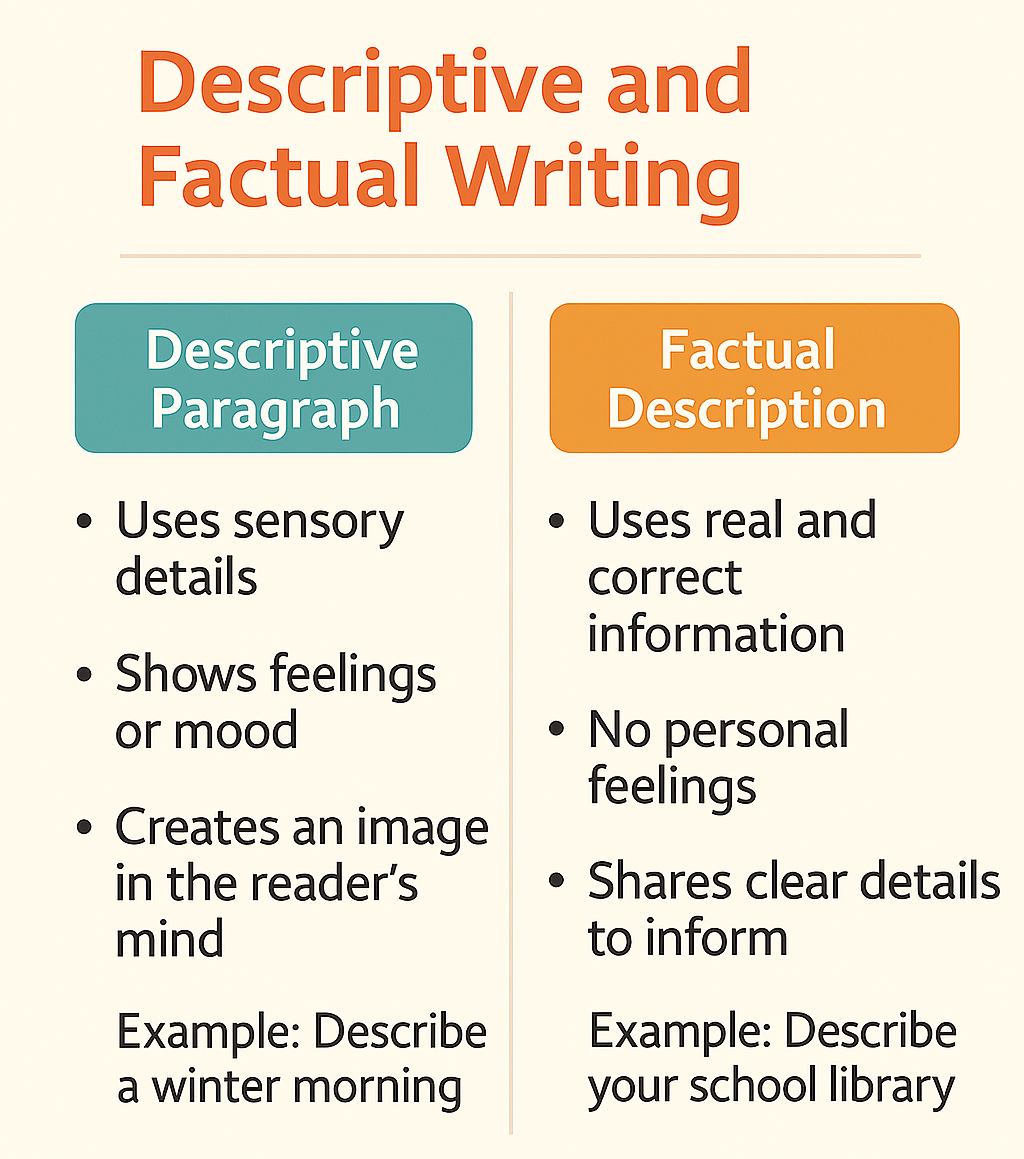
Difference Between Factual Description and Descriptive Writing Class 9
Descriptive Writing Format Class 9 (Easy to Remember)
Move step-by-step so the reader can imagine it easily.
Factual Description Examples for Class 9 Students
Example 1
Qu – Write a factual description of the new Smart Classroom in your school in about 100–120 words.
Answer – Our school has a new Smart Classroom. It looks bright and modern. A big digital screen is fixed on the wall. Teachers use it to show pictures and videos. There is a projector and a computer on the teacher’s desk. The room has clean walls and bright lights. Each student has a comfortable chair and desk. The classroom is air-conditioned and well-ventilated. The smart board is used instead of a blackboard. It helps teachers explain lessons clearly. Internet connection makes learning easy and quick. Students enjoy watching lessons on the screen. The Smart Classroom makes study fun and helps everyone understand better.
Example 2
Qu – Write a factual description of the School Computer Lab in about 100–120 words.
Answer – Our school has a big Computer Lab with the latest computers. There are thirty computers placed neatly on long tables. Each computer has a monitor, keyboard, and mouse. The lab is fully air-conditioned and well-lit. The walls are clean and painted in light colours. Internet connection is fast and always working. Students learn typing, coding, and drawing on computers. A smart projector helps teachers show lessons clearly. The lab also has printers and speakers for practical use. Every computer has antivirus software for safety. One computer teacher looks after the lab and guides the students. The Computer Lab helps students learn technology and prepares them for the modern world.
Practice Questions for Factual Description Class 9
1. Write a factual description of the Science Laboratory in your school in about 100–120 words.
2. Give a factual description of your School Library and mention its main features.
3. Write a factual paragraph about a Tree Plantation Drive organised in your school.
4. Give a short factual description of your School Auditorium and how it is used.
5. Write a factual description of a Cleanliness Drive held in your neighbourhood.
Descriptive Paragraph Examples for Class 9 Students
Example 1
Qu – Write a descriptive paragraph about a Rainy Morning in about 120–130 words.
Answer – It was a calm rainy morning when the sky looked soft and grey. The trees outside my window danced gently in the cool breeze. The streets were wet and shining, and little puddles reflected the passing clouds. The sound of raindrops falling on the roof created a peaceful rhythm. People walked slowly with colourful umbrellas, and the air smelled fresh and earthy. School started late that day, so I stood by the window, enjoying the beauty of nature. Everything looked clean and bright after the rain. That rainy morning brought a sense of calmness and joy, making it one of those rare days when the world feels quiet, beautiful, and alive at the same time.
Example 2
Qu – Write a descriptive paragraph about Your School Canteen in about 120–130 words.
Answer – Our school canteen is one of the busiest and most cheerful places on the campus. It is clean, well-maintained, and filled with the smell of freshly prepared food. Students visit it during recess to enjoy snacks like sandwiches, samosas, and fruit juice. The counters are arranged neatly, and the staff members serve food politely. There are several tables and benches where students sit together and enjoy their meals. The walls are painted in bright colours, giving the place a lively look. A notice board displays the menu of the day. The canteen also sells healthy options like sprouts and salads. It is not just a place to eat but also where students share laughter and friendship during the short break from studies.
Practice Questions for Descriptive Paragraph Class 9
1. Describe a science exhibition held in your school.
2. Write a paragraph on your favourite festival and how it is celebrated.
3. Describe your study room and the things you like most about it.
4. Write a paragraph on a morning walk in your neighbourhood park.
5. Describe a hill station you visited during your holidays.
Common Mistakes to Avoid in Descriptive Writing Class 9
Many students make small mistakes while writing descriptive paragraphs. Here are some simple tips to help you avoid them and write better
Quick Revision Notes
Here are some short and easy revision notes to help Class 9 students remember the main points of Descriptive Writing. These notes follow your simple and conversational style rules.
Add main details in proper order.
End with a closing line that gives a complete picture.
Add sense words like see, hear, feel, or smell.
Use easy adjectives such as clean, bright, soft, or fresh.
Don’t write very long sentences.
Don’t forget to end the paragraph neatly.
FAQs
Q1. What is the main difference between descriptive writing and factual description?
Answer – Descriptive writing shares what you see and feel, using imagination and sense words. Factual description gives real information with correct facts and figures, without adding feelings.
Q2. How can I know if the question is asking for a factual description or a descriptive paragraph?
Answer – If the question asks for facts, numbers, or clear details (like “Describe your school library”), it’s factual. If it asks you to show a scene or create an image (like “Describe a rainy day”), it’s descriptive.
Q3. What are some easy tips to improve descriptive writing?
Answer – Observe things around you closely. Use simple adjectives, short sentences, and sense words. Write in a proper order and end with a clear closing line.
Q4. How can I make a factual description look more complete?
Answer – Add all important details — name, place, time, purpose, features, and results. Keep sentences short and direct. Avoid opinions or personal thoughts
Q5. What mistakes should I avoid in both types of writing?
Answer – Don’t repeat ideas or use hard words. Don’t write without planning. Always follow order and keep your sentences neat and clear.
Q6. How many words should I write for Class 9 descriptive or factual paragraphs?
Answer – Usually, the word limit is 100–120 words. It’s better to stay close to the limit because long answers often lose focus.
Q7. How can I get better marks in descriptive and factual writing?
Answer – Follow the correct format, use easy grammar, and write neatly. Show clear understanding, stay within the topic, and check for spelling or punctuation errors before submitting.
Q8. Can I use the same structure for both descriptive and factual writing?
Answer – Yes, but with a difference in tone. Descriptive writing uses feelings and pictures. Factual writing uses facts and short, exact lines.
Q9. Should I give a title in both descriptive and factual writing?
Answer – Yes, always. A short, suitable title makes your work look neat and complete.
Q10. How can I practise for improvement?
Answer – Write 2–3 short paragraphs every week. Choose simple topics like My School Garden or Smart Classroom. Read them aloud to check if they sound clear and natural.
