Have you ever read a paragraph that felt so real you could almost see it happening? That’s the power of a good descriptive paragraph. In Class 11 English, descriptive and factual writing help you turn ordinary details into clear, vivid pictures that readers can easily imagine.
In this post, you’ll learn the real meaning of a descriptive paragraph and factual description for Class 11, along with easy examples, clear formats, and short passages that will help you write better.
Table of Contents
What Is Descriptive and Factual Writing?
Descriptive Writing
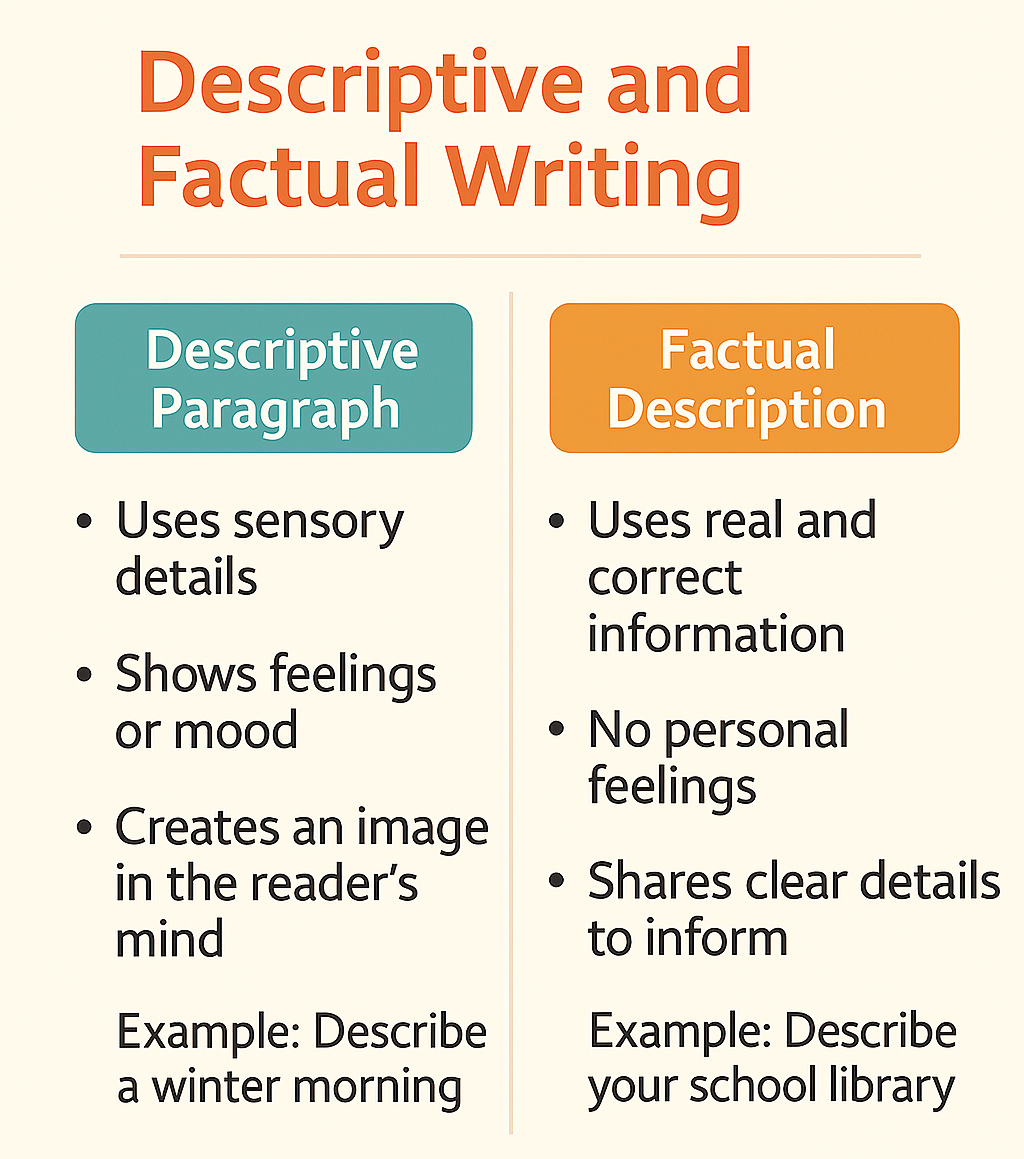
Descriptive writing paints a picture with words. It uses sensory details to describe a person, place, object, or event so the reader can imagine it easily.
Example – Describing your classroom by mentioning its look, sound, and atmosphere.
Key idea – It focuses on imagination, feelings, and detailed expression.
Easy Formula to Write Descriptive Paragraph (Very Simple)
Start – Main idea (What are you describing?)
Middle – Add clear sensory details (how it looks, sounds, feels)
End – One small line showing the mood or final impression
One sentence each → then expand.
This keeps writing clean and smooth.
Factual Writing
Factual writing presents real and accurate information in a clear, organised way. It avoids emotions and personal opinions.
Example – Giving exact details about your classroom—its size, furniture, and purpose.
Key idea – It focuses on truth, clarity, and structure.
Easy Formula to Write Factual Description
Difference Between Descriptive and Factual Writing
When we describe something, we notice it through our senses.This small table will help you decide what to describe:
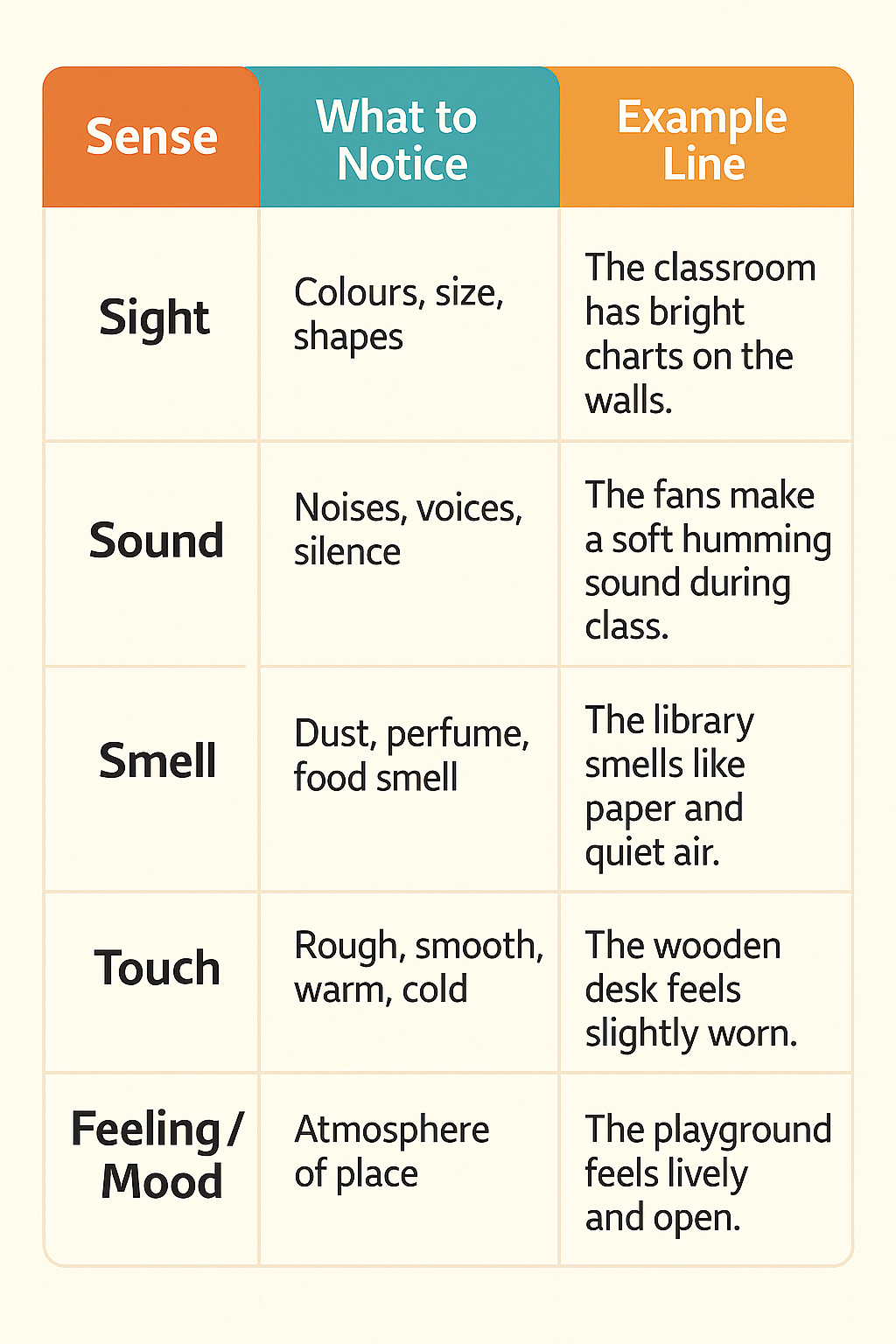
Use only what fits naturally. No need to add all five in every paragraph.
How to Write a Factual Description – Step-by-Step Guide
For a place – location, size, features, purpose
For a person – name, age, profession, appearance, qualities
For an event – date, venue, purpose, main highlights
Factual Description Examples for Class 11 Students with Practice Samples
Example 1
Qu – Write a factual description of The Annual Sports Day organised in your school in about 100–120 words.
Answer – The Annual Sports Day of our school was held on 14th December in the school playground. The event began with a short opening ceremony and a march past by all the four houses. The chief guest, the District Sports Officer, declared the meet open. Many events like races, long jump, and relay were organised. Students took part with full enthusiasm and team spirit. The winners were given medals and certificates. The chief guest praised the school for encouraging sports and discipline among students. The day ended with the national anthem and great cheer from everyone present.
Example 2
Qu – Write a factual description of The Library of Your School in about 100–120 words.
Answer – The library of our school is one of the most peaceful and organised places on the campus. It has more than 8,000 books, including storybooks, reference books, and journals. The library is divided into sections for fiction, non-fiction, and academics. Students can sit quietly and read or borrow books for a week. It is fully air-conditioned and has a digital corner for online research. The librarian helps students find the right books. The library truly supports the habit of reading and learning in our school.
Example 3
Qu – Describe A Famous Historical Monument You Visited in about 100–120 words.
Answer – Last month, I visited the Red Fort in Delhi with my family. It is a grand historical monument made of red sandstone. Built by Emperor Shah Jahan in the 17th century, it shows the rich Mughal style of architecture. The fort has beautiful gates, large walls, and gardens. The Indian Prime Minister hoists the national flag here every Independence Day. The fort reminded me of India’s glorious past and filled me with pride. It is truly one of the most famous monuments in our country.
Bad Example vs Good Example (So Students Understand Clearly)
Bad – My classroom is very good. It is big. Everyone likes it.
Why it is bad?
Because it is flat, unclear, and does not show anything.
Good – Our classroom has wide windows that let warm sunlight enter in the morning. The chairs are arranged in neat rows, and a colourful notice board hangs near the door. Charts made by students add brightness to the walls. The room feels open and cheerful, and everyone likes spending time here.
Practice Questions for Students
Try writing these on your own:
1. Describe your school assembly ground.
2. Give a factual description of your class teacher.
3. Describe a rainy afternoon in your city.
4. Write a factual description of your school computer lab.
Common Mistakes to Avoid
- Overuse of adjectives or unnecessary details.
- Mixing facts and opinions.
- Ignoring word limit or structure.
- Repeating sentences or phrases.
FAQs
1.What is a descriptive paragraph and what is its purpose?
Answer – A descriptive paragraph is a short piece of writing that shows how a person, place, object, or moment looks, feels, or sounds. The purpose is to help the reader form a clear picture in their mind, almost as if they are experiencing it themselves. Writers often use simple sensory details like colour, sound, temperature, and mood to make the scene feel real.
2. How do I become better at descriptive writing?
Answer – You become better at descriptive writing when you start noticing small details around you and express them in clear, simple language. Try observing a place for one minute and write what you see, hear, and feel, without rushing. The NCERT Class 11 English book shows how everyday scenes can be described using natural details, not big vocabulary.
You can check real examples in the NCERT English Textbook (Class 11) –
https://ncert.nic.in/textbook.php?hbeng1](https://ncert.nic.in/textbook.php?hbeng1
You can also learn practical description techniques from the British Council’s English learning section –
https://learnenglish.britishcouncil.org/](https://learnenglish.britishcouncil.org
3. How long should a descriptive paragraph be?
Answer – A descriptive paragraph is usually about 100–150 words for Class 9–11 level writing. This length is enough to show clear details without making the description too long or confusing. The idea is not to count every word, but to describe one scene or one subject in a clear and focused way. In CBSE exams, most long-answer questions are also planned around this range. You can see this word limit pattern in the CBSE Sample Papers:
https://cbseacademic.nic.in/SQP.html](https://cbseacademic.nic.in/SQP.html
The NCERT Class 11 English writing section also follows similar practice length in examples:
https://ncert.nic.in/textbook.php?hbeng1](https://ncert.nic.in/textbook.php?hbeng1
So, the best approach is to keep one strong main idea and describe it smoothly within this word range.
4. How do you end a descriptive paragraph?
Answer – A descriptive paragraph usually ends with a line that captures the overall mood or final impression of the scene. The last sentence should feel natural, not forced. For example, if you described a winter morning, you may end by showing how the sunlight slowly brings comfort. This closing line helps the reader understand how the writer feels about the moment. You can see how endings are used in the descriptive passages of the Class 11 NCERT English textbook here:
https://ncert.nic.in/textbook.php?hbeng1](https://ncert.nic.in/textbook.php?hbeng1
CBSE sample papers also show similar paragraph structure patterns:
https://cbseacademic.nic.in/SQP.html](https://cbseacademic.nic.in/SQP.html
5. What is the difference between paragraph writing and descriptive paragraphs?
Answer – Paragraph writing is a general form of writing where the focus is mainly on explaining an idea, event, opinion, or fact in a clear and organised way. It may talk about thoughts, reasons, examples, or information depending on the topic. A descriptive paragraph, on the other hand, focuses only on how something looks, feels, sounds, or appears, so the reader can imagine it as a picture.
For example, NCERT Class 11 English textbooks include different types of paragraphs—analytical, narrative, factual, and descriptive. Descriptive paragraphs specifically use sensory details and atmosphere to create a visual image in the reader’s mind. You can compare actual paragraph examples here in the official NCERT English textbook (Class 11):
[https://ncert.nic.in/textbook.php?hbeng1](https://ncert.nic.in/textbook.php?hbeng1)
CBSE Sample Papers also show that descriptive paragraphs are evaluated on clarity and imagery, not on arguments or logic:
[https://cbseacademic.nic.in/SQP.html](https://cbseacademic.nic.in/SQP.html)
6. Is a ‘biography’ paragraph narrative or descriptive?
Answer – A biography paragraph can be both, but most of the time it is narrative because it tells the events of a person’s life in time order—childhood, education, achievements, and later years. But it also becomes descriptive when we talk about the person’s appearance, personality, or nature. For example, in NCERT Class 11 English, biographical sketches highlight both life events and personal qualities. You can see real examples in the official NCERT English Book:
[https://ncert.nic.in/textbook.php?hbeng1](https://ncert.nic.in/textbook.php?hbeng1)
CBSE also includes biography writing under short composition formats in Sample Papers:
[https://cbseacademic.nic.in/SQP.html](https://cbseacademic.nic.in/SQP.html)
